
Kuliah Tamu Magister Agribisnis 2026 “DIGITAL MARKETING AS A STRATEGIC TOOL FOR PROMOTING AGRICULTURAL PRODUCT”
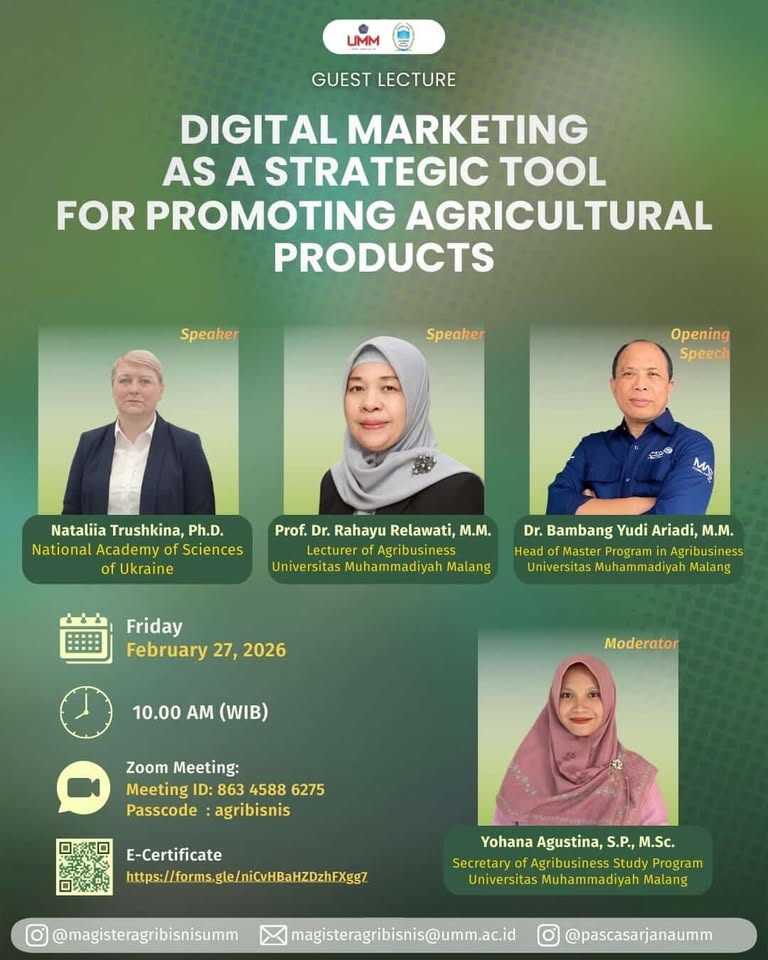
OPENING SPEECH KAPRODI MAGISTER AGRIBISNIS Assalamu’alaikum warahmatullahi wabarakatuh, Good morning and warm greetings to us all. Distinguished guest speaker, respected lecturers, students of the Master Program in Agribusiness, and all participants of today’s guest lecture. First of all, let us express our gratitude to Allah SWT for His blessings, which allow us to gather today in this Guest Lecture of the Master Program in Agribusiness with a highly relevant and strategic theme: “Digital Marketing as a Strategic Tool for Promoting Agricultural Products.” As the Head of the Master Program in Agribusiness at Universitas Muhammadiyah Malang, I would like to express my sincere appreciation for the organization of this academic event as part of our commitment to strengthening an international academic atmosphere and enriching students’ insights in responding to the dynamics of global agribusiness. Distinguished participants, We realize that today’s agricultural sector can no longer rely solely on production strength. Comparative advantages such as fertile land and abundant natural resources must be complemented by competitive advantages based on innovation, technology, and strategic marketing. Digital transformation has significantly changed the way products are produced, distributed, and—most importantly—promoted to consumers. In this era of disruption, marketing is no longer limited to selling harvests in traditional markets or through conventional distribution chains. Digital marketing has become a strategic instrument that is able to: Expand market access beyond geographical boundaries, Increase product value through branding and storytelling, Connect producers directly with consumers through shorter supply chains, and Generate consumer data to support more precise business decision-making. Digital platforms, social media, marketplaces, and even big data analytics have opened new opportunities for farmers, cooperatives, agribusiness SMEs, and agricultural startups to upgrade their competitiveness. However, our challenge lies not only in mastering technology but also in transforming our mindset—from production-oriented approaches to market-driven agribusiness. Students of the Master Program in Agribusiness are expected to become agents of transformation who bridge the gap between farmers and digital markets. You are required not only to understand marketing management theories but also to design contextual, adaptive, and data-driven digital strategies for agricultural commodities—whether in horticulture, food crops, plantations, or processed products. Today’s theme strongly aligns with the vision of our Master Program in Agribusiness, which is to produce graduates who excel in developing sustainable agribusiness systems based on innovation and technology. Digital marketing is an integral part of the modern agribusiness ecosystem, oriented toward sustainability, supply chain efficiency, and the improvement of farmers’ welfare. Through this guest lecture, I hope that students will be able to: Understand the strategic framework of digital marketing in the context of agricultural products, Identify opportunities and challenges in its implementation in Indonesia, and Develop a global perspective while maintaining local relevance in agribusiness digital marketing strategies. This event also reflects our commitment to continuously fostering academic collaboration at both national and international levels to enrich knowledge and expand students’ professional networks. Finally, I encourage all participants to actively engage in this session, participate in discussions, and take full advantage of this valuable opportunity to deepen your understanding and broaden your perspectives. May this event provide meaningful contributions to knowledge development, academic capacity building, and tangible progress for Indonesia’s agribusiness sector. Wassalamu’alaikum warahmatullahi wabarakatuh. Thank you. Dr. Ir. Bambang Yudi Ariadi, MM